Marco Delaney

Tamás Yvan Topolánszky’s Oscar-qualified short turns a boy’s fight for survival into a drama about who gets to decide what words mean. Its remarkable young lead and the precision of its storytelling make it a standout contender for Best Live Action Short Film.
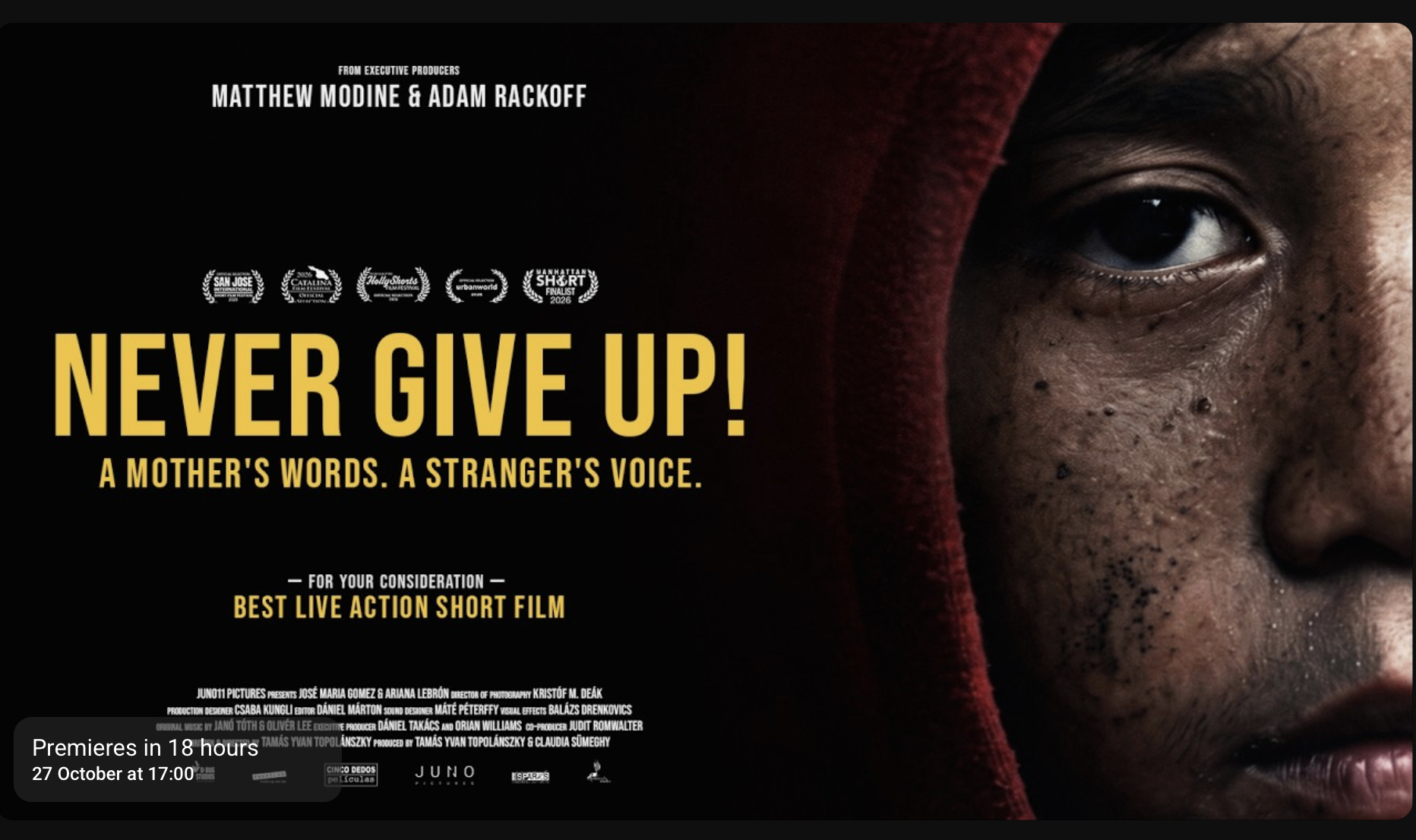
The most moving moment in Never Give Up! depends on a sentence most of us have learned to tune out. A young boy, separated from his mother during a deadly border crossing, is alone in the desert with a damaged phone. As exhaustion sets in, he hears three words in an old motivational video that he has heard countless times before. His mother taught them to him. Now a stranger is saying them. “Never give up” lands with the force of something meant just for him.
That moment is the measure of what writer-director Tamás Yvan Topolánszky achieves in this exceptional short. He builds a survival story around a change in meaning. The words begin as a mother’s advice, return as a piece of mass-market inspiration and become, in the boy’s hearing, a reason to keep going. The language stays exactly the same. By the time we hear it again, our understanding of it has changed with his.
The choice of Donald Trump as the voice in the video gives the scene its political charge. An American audience is likely to recognise the speaker and bring its own associations to the moment. The boy has no idea who he is. What registers for him is the echo of his mother. Topolánszky trusts those two experiences to coexist, leaving viewers to sit with an irony the child has no reason to notice. That gap between what the audience knows and what the character needs is where the film does some of its finest work.
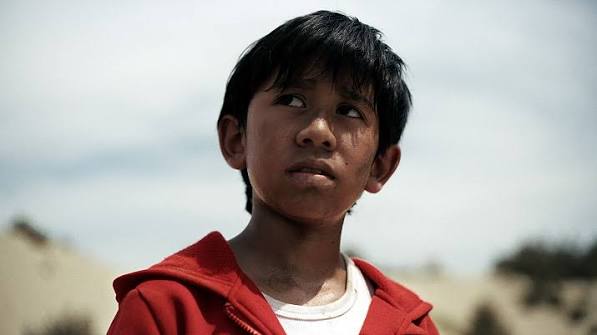
Nine-year-old Mexican newcomer José María Gómez “Chema” carries an extraordinary amount of the film on his first screen outing. The premise asks him to make an inward event, the recognition of his mother’s words in a stranger’s voice, matter as much as the physical danger around him. He makes that recognition feel entirely believable. Ariana Lebrón gives the film its emotional foundation as his mother. Her influence is felt well after the two are separated, and the turning point depends on our believing that her words have a meaning particular to the two of them.
There is plenty here for veteran filmmakers to appreciate. A damaged phone creates a practical uncertainty. The repeated phrase ties the boy’s immediate predicament to his relationship with his mother. The video brings the politics of the border into the scene through something the boy encounters, keeping the drama grounded in his point of view. Each element deepens the others. That economy is especially impressive in a short, where a single line of dialogue can have to carry the weight of an entire relationship.
Topolánszky first began thinking about the film during the 2015 refugee crisis in Budapest, when he was struck by the distance between political language and individual experience. The finished short gives that idea a dramatic form. The border determines the danger the boy is in. His mother determines what he hears. Holding both truths in the same moment gives the film a complexity that lingers well beyond its immediate suspense.
Named one of the top ten live-action finalists at HollyShorts, Never Give Up! has a strong case in the Oscar race. It has the direct emotional pull of a finely told survival story, a debut performance that can hold the centre of the film and a pivotal scene that invites a second viewing. The first time, you want the boy to survive. The second time, you hear his mother in those words a little sooner.


Leave a Reply