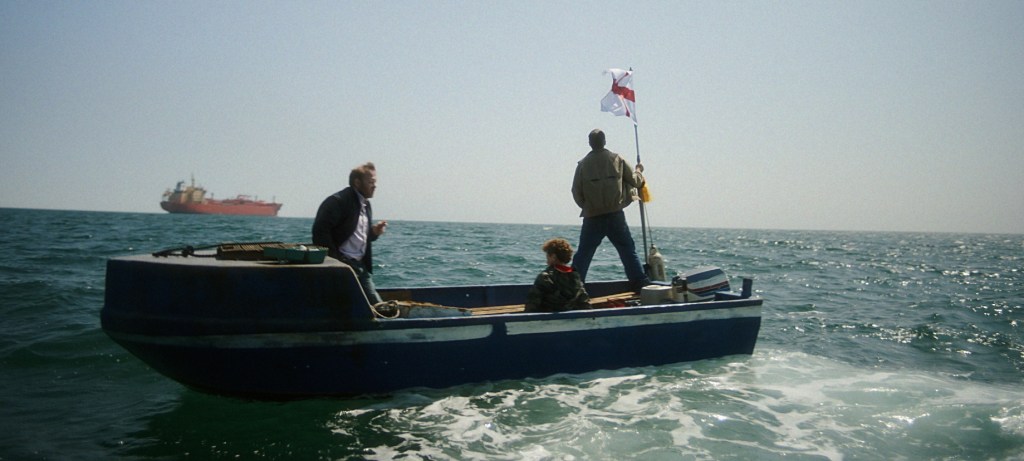
RULE, BRITANNIA tackles the debate around refugee small boats through the story of two brothers who set out to tackle a perceived threat, only to find themselves relying on the very people they intended to stop. What made this the right story to tell now, and what initially sparked the idea?
For us, the crazy thing about the timing is that we wrote this in 2024, when vigilantism in the Channel was a fictional construct which we thought was a good allegory for the potential direction that hateful politics could take us. So we hoped that this was a kind of dystopian fantasy of a future that wouldn’t come.
And yet here we are in 2026, during our festival run, and there really are people taking boats out into the Channel with the intention of harming refugees and trying to prevent refugees being rescued. So it’s really desperately sad how prescient it is.
As a dad i feel terribly worried that the politics of hate becoming more and more mainstream feels like a threat to the future of our country. And it feels to me like if we allow these kinds of politics to become even acceptable, let alone mainstream, then we risk our kids growing up in a world where hate and racism and hate crime are the norm rather than the exception.
And so we wrote the film in the hope that we could explore where this political extremism might take us. And now here we find ourselves with exactly the situation that we depicted happening for real.
Obviously the refugees haven’t rescued Danny Tommo, but apart from that it’s pretty much letter for letter. I mean, his boat even sank!
Could you explain how you established a sense of character for the brothers, representative of such a prejudiced force in society, without turning them into caricatures?
It was very important to me that these characters were relatable. That one of them’s a dad and the other is the uncle of the child on this boat. And that in some ways it feels like a kind of fun day out that’s got out of control. They got on the beers and then they had this idea to take a boat, and one thing led to another. It’s all a bit of a classic British caper.
That idea was very important to me, that we didn’t portray these people as two-dimensional villains.
I believe that if filmmakers take this approach, that we just sneer at those we disagree with and present them as two-dimensional idiots, then we are on a fast route to having someone like Nigel Farage in Downing Street.
The truth is that the situation around immigration is incredibly nuanced, and the people who have genuine concerns about immigration are not all a bunch of racist psychopaths. I think for the most part they are people who worry for their own families and their own futures, and who are being manipulated by the super-rich and the media into believing that their main enemy is a few people fleeing war, rather than divisive politicians an the ultra rich.
The working class are pitted against each other and against equally unfortunate people.
So I wanted the brothers to feel like real human beings. They’ve been out on the lash. We’ve all been out on the lash. We’ve all had a laugh. Walshy is angry, and that anger is real, but crucially his brother Rob has just got caught up in it because it was a laugh last night when they were drunk. And they brought his son along because it’s a caper.
And there’s a lot of complicated stuff around masculinity, particularly with disenfranchised men.
So here they all are out on the water, and I really wanted to make sure that they didn’t have George Cross tattoos and act in a way that was completely unforgivable from the start. Because the whole point is to raise questions and to explore these characters rather than to demonise them.
Why did you choose to make the ‘role reversal’ for the brothers as they became at the mercy of those they had intended to harm a central element of the film?
Well, this role reversal was the idea from the very start. There was nothing really else when I started beyond the idea that these people who hate so viciously have often never had their lives put in danger, and they’ve never known what it is like to fear for one’s life.
So the central question for me was, how would these people feel if it was them whose lives were in danger? Their families, their children?
And so that role reversal is the heart of the film, and everything else built out from there.
And actually, one thing that I discovered during the making of the film is this central question which fascinates me:
Would you save your enemy from drowning?
Would you save a human being who had set out to harm you, possibly even kill you, if they were drowning at sea and you had the opportunity to save their life?
And if you do that, what does that mean about your humanity?
And if you cannot bring yourself to do that, what does that mean about your humanity?
When constructing the rhetoric that the brothers would use about migrants, which sources did you draw from – was there one particular social media platform that you decided the brothers had been using?
I began following Danny Tommo before he called himself Danny Tommo, and Tommy Robinson and Nigel Farage, and I follow a lot of far-right news channels and social media feeds. I think it’s very important to understand these people.
But also, very importantly, I worked with my co-writer Ayman Alhussein, who is an incredibly bright and insightful man, who has lived in the Calais Jungle, who has been abused by these people and who has made a boat journey himself.
So between us we really wrestled this story into life, and we really tried to bring this rhetoric to life in a way that was as humane as possible. Because you can’t just have characters say things which make them irredeemable from the start, and then there’s nowhere to go.
So it was important for us that we built the thing in layers.
And I want these characters to be as rich and as open to interpretation as possible.
I want this film to speak to a wider audience, and I want to keep developing my craft. I think that subtlety and giving the audience credit for joining the dots is a great skill of brilliant writer-directors, and it’s something that I’m always interested in exploring in my own work.
Max, are there elements of your career as a youth worker that you brought with you into the film – how directly did it inform the way you approached RULE, BRITANNIA?
Yes, absolutely. Tonnes of elements of my youth work background came into play in this film, and in all my films.
I am a self-taught filmmaker, and I learned to make films whilst working with vulnerable kids in young offenders institutions and in refugee centres and within the community.
And I have always believed in empowering voices who are not usually heard, and I’ve always believed in working in a very collaborative way and trying to empower my cast to bring their voices and their experiences to life in ways which are as unmediated as possible, so we don’t feel the kind of dread hand of the director.
And so in this case I did that.
For example, with the casting of the little boy, I knew that I was going to have to cast a very tough boy, and I work a lot with kids in my commercial work and in my other shorts.
So I took Tom Page-Turner to a cold swimming pool and worked with him for quite a long time in that pool, practising the drowning scenes and exploring his resilience.
I also had myself put into the English Channel by the team so that I could feel how cold it was, so that I would understand what the actors were going through.
So I work in a very immersive way and in a very hands-on way, and that absolutely comes from my background as a sort of sleeves-rolled-up community filmmaker.
Your previous work spans documentary and commercial filmmaking, including projects for the Red Cross, Guide Dogs and CALM. What attracted you to narrative drama as a way of exploring politically charged subjects, and what can fiction communicate that documentary sometimes cannot?
That’s another great question, and I’m not sure I know the answer yet because I’m really just learning about how to make drama.
I always wanted to tell stories with heart. I believe that the heart in my work is what defines it. I work with my heart on my sleeve, and I want to bring heart and big feelings and authentic emotion to screen in a way that matters.
And I think that’s a strand throughout my work.
I feel very strongly about suicide, which has affected my life deeply, and I feel very strongly about this refugee topic, having worked with lots of refugees in my life. And much of my documentary work was with vulnerable young people and kids in the justice system, with whom I had a lot of empathy and had worked a lot.
So my work comes from a place of deep personal experience, and that’s where I think I can be most effective as a storyteller.
And my ambition is to keep learning and keep developing and keep finding ways to tell these stories with big heart, and which matter, and which challenge division, and which open up conversations.
I’m not interested in trying to tell people what to think. Even my commercials are really designed to create a place for the viewer to think rather than to try to tell them what to think, which I think is lame. And there’s really no point in doing it if you’re not asking questions. Then why are you doing it?
I have a really wonderful quote by Jordan Peele which I love and which is in my mind and my heart a lot at the moment, where he said that you shouldn’t really be making films unless you are exposing something of yourself, a vulnerability which you are afraid to share with the world.
And I think all my work addresses different parts of me which are troubled or for which I feel ashamed, or just plain old sad, or worried about.
And I think that personal work, really deeply personal work, is the only work that’s really worth making.
And I think that I can carry that ideology into drama, and I’m very excited about that.
The film brings together an experienced cast, including Olivier Award-winning Michael Jibson, alongside cinematographer Luke Jacobs, Oscar® and BAFTA-winning editor Stephen Dunne, and award-winning composer Jon Clarke. How did you assemble the team, and what did each collaborator bring to the project?
I’m lucky at this point in my career to be a relatively busy commercial director, which means that I’m able to put some money into my own shorts. Because it’s so hard to get short films made. It’s such a long process waiting for funding, and there’s so much gatekeeping.
So my philosophy is that I’ll just work as hard as I can shooting ads, and then I’ll put as much money as I can into my passion projects. And then I bring in the teams with whom I’m making commercials, with whom I have a great shorthand and who understand me and the stories that I want to tell.
Luke Jacobs is a great example. He and I have come up together. We’re like two arms on the same body once we’re on set. He and I are out in Bangkok shooting a job right now, and I just find working with him a joy.
Our work has evolved together, and I think we both share a lot of the same values, and I hope that comes across on screen.
In terms of Stephen Dunne, we were just incredibly lucky that he engaged with this project. He’s a wonderful, incredibly talented guy, with more awards than you could build a house with. And he really challenges an idea and interrogates it and brings so much, particularly with things like those amazing music choices.
And it’s not just them. We had this fantastic music team, brilliant post partners.
The Black Kite team, for example. In the end the sea was so scary that we couldn’t shoot deep out in the Channel for the whole shoot, so we had to come back nearer shore, which meant we had a lot of horizon in some of our shots.
And the team at Black Kite were just amazing in getting rid of that, because it was very important for me that we felt that we were truly at sea for the whole film.
The team at Factory who did our sound were amazing.
And my producers Maddie Easton, Sam Topley, Dave Burchill, Kate Taylor and James Howland. These are really experienced, big-hearted, good people who I could not have done this work without.
What role do you believe independent filmmaking can play in exploring subjects that are often polarising in public debate?
I think it can be really helpful if we can get the work out in front of people.
So much of this work is didactic and polemic, and it’s only really helpful if you leave enough room for people to see themselves within it and to think about things and to interpret.
I do believe it can be helpful, but I also believe that in an incredibly polarised time, work has to be pitched in a very clever way in order to speak to both sides of the debate.
I think the danger is that sometimes political filmmaking becomes about reinforcing what people already believe, rather than challenging them to think differently. And if all we’re doing is making people on one side feel that they’re right, while making people on the other side feel hated or dismissed, then I don’t know really how that helps.
For me, the interesting thing is whether you can make something that actually opens up a conversation between people who might otherwise never listen to each other.
Max, you are developing your first feature, while Sam has established Tarot as an independent studio. How do you hope the profile of RULE, BRITANNIA will help move those ambitions forward?
I really don’t know, and the most important thing for me right now is learning.
Since making this film and spending all of this year going to wonderful film festivals all over the world, and seeing so many brilliant short films, I’ve just found it incredibly exciting and inspiring.
And so I just love the journey. I want to meet the filmmakers, learn from them, learn from their films and get myself to a point where I’m ready to make my first feature, and that feature will be really good.
I think that I have learned a huge amount from Rule Britannia, and probably the next thing for me is to continue to hone my craft. I think I’ll make another short whilst developing feature scripts, and what comes next I don’t know.
I love shooting commercials, and I’m desperate and very excited about the possibility of becoming a feature film director.
I’m currently attached to a development project which is an option of a very famous autobiography, which could be amazing if it comes off, which I can’t name now. But I was amazed to be approached for it, and it shows, I guess, that I have some momentum and that some really exciting opportunities are starting to open up.
I guess the next stage will be to find an agent, so any agents out there who read this, feel free to reach out!
Thanks a million. I’ve really enjoyed doing this interview.


Leave a Reply