1. Has that experience as a producer on BEYOND SILENCE influenced your approach to this Oscar campaign?
Enormously, although I have to admit we never expected to be back in this race so soon after Beyond Silence.
The biggest lesson was timing. With Beyond Silence we came into the awards season relatively late, and in the first weeks it felt like we had a lot of catching up to do. For instance, most screening venues were fully booked. With Odessa we started the moment the film began performing strongly on the festival circuit and we were approached by our publicist, who we knew could take us all the way.
The second lesson was less glamorous but just as useful. An awards campaign runs on materials — stills, press kits, a website, screeners, subtitled versions — and every single one of them takes longer to produce than you think. Having been through it once, we knew what to have ready before anyone asked for it. It buys you the freedom to say yes quickly and act accordingly.
2. What are your main sources of inspiration from elsewhere in the film industry?
Sergio Leone, more than anyone, for this film. The recurring silhouette walking toward the camera in Odessa is a direct descendant of Once Upon a Time in the West. A figure you cannot yet identify, approaching slowly, is both ominous and irresistible: you dread what is coming and you cannot look away. Odessa is built entirely on that kind of withholding rather than showing.
There is a second debt to the same film: in Odessa the howl of the Carnyx horn morphs into the whistle of a train, the way Leone lets the sound of a gunshot morph into a train whistle in this amazing film.
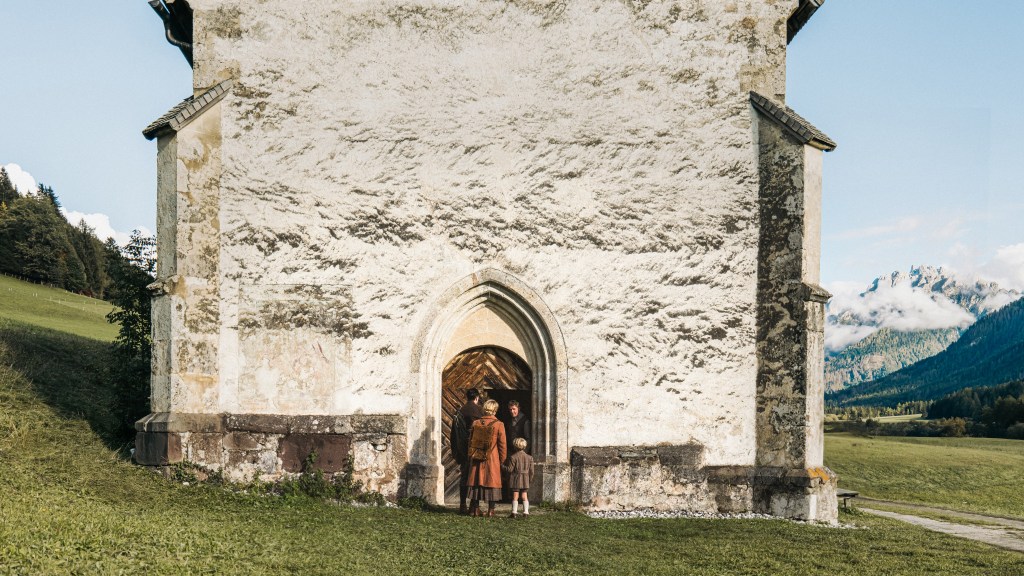
And Quentin Tarantino. The lunch scene in the mountain hut is lit the way he lit the farmhouse at the opening of Inglourious Basterds. We sawed a hole in the roof of the hut to the hay storage above, where we placed an abundance of film lights to pour onto the table and bounce up into the actors’ faces, and added hard shafts of light through the gaps in the timber. We stole it outright, which I think he would approve of: Tarantino once said that “great artists steal, they don’t do homages.” There is a nice symmetry to it, because Tarantino has always said Leone was his own biggest influence.
And finally the greatest Dutch filmmaker working today: cinematographer Hoyte van Hoytema. When he won his Oscar for Oppenheimer, he used his speech to urge aspiring filmmakers to try “that incredible new hip thing called celluloid.” I took him at his word. Shooting Odessa on 35mm was brutal and magical in equal measure, and the film has exactly the vintage look I saw when I was writing it.
3. What was the casting process like for ‘ODESSA’ – what made you choose Bastian Beyer and Magdalena Müller for the lead roles? [The actors’ names have been corrected]
For Josef, I needed one specific thing: an actor whose face could move from kind to cruel in a single heartbeat. We received over 180 applications. Bastian’s self-tape settled it instantly. In person he is a really likeable guy, but without visible effort he can shift his expression, and you recoil at the coldness in his face.
There was one feature the role needed that Bastian did not have: a gap between his front teeth. Survivors described Mengele again and again as strangely charismatic. One even compared him to a movie star, with slicked-back dark hair and a prominent dental gap. I did not want to cast for the gap, because that ability to turn from kind to cruel mattered far more. So we asked Bastian to visit his dentist in his hometown to have his teeth measured for a dental prosthetic. He wore it for a month before the shoot, until he was completely used to it. Every survivor account mentioned that gap, and I felt we owed them that detail.
For Irene, Magdalena was one of very few actresses who instinctively understood the year the film is set in: 1949, when emotional restraint was simply the default. A wife’s grief and rage toward her husband lived inside her body, in her throat, not in big gestures or a raised voice. Magdalena did exactly that in her casting tape, and I knew I had found my Irene.
4. How did you ensure that ‘ODESSA’ was both historically accurate and universally relevant?
In my view, these two are actually the same challenge.
The premise the whole film rests on, that Mengele was genuinely and demonstrably kind to children, could not be something I invented for dramatic effect. If I had made it up, the film would be a trick. So I spent almost a year on research to establish that it was real, including a visit to Auschwitz with my cinematographer and production designer. It is real, and documented repeatedly. And the moment you know it is true, the film stops being a historical curiosity and becomes a warning that is unsettlingly relevant today: monsters don’t come dressed as monsters.
Beyond that, I am a history buff, so I packed the film with period detail, far more than any viewer will consciously register. Dialogue drawn from real correspondence, references to his death, the code word, a nod to the White Rose resistance, the twins. I do not expect any audience member to catch all of it. But I think people can feel when a film has been made with meticulous attention to detail.
5. You founded Exosphere and have worked across directing and producing. How does that combination of roles influence the way you develop projects, particularly when you’re trying to balance a strong creative vision with the practical realities of independent filmmaking?
I got into producing for one reason: freedom. I wanted to tell the stories I wanted to tell, in the way I wanted to tell them. Any other producer would have looked at Odessa, a period film shot on celluloid in the Dolomites in October by a relatively inexperienced director, and called it an unacceptable risk.
That said, wearing both hats is not always comfortable. The clearest example was the number of shooting days. The producer in me was happy that we could do it in a shoot of a mere six consecutive days. The director in me was understandably less delighted. And on other days it was the other way around. You end up negotiating with yourself, which is efficient, but you never quite win the argument.
Which is why I am glad Rianne Beenes, who produced Odessa with me, will be Exosphere’s lead producer on the projects ahead. My heart lies with writing and directing, and she understands better than anyone what my films need. With these first films I also wanted to show that we can carry a production of real scale, so the next, bigger story does not have to start by convincing someone we can handle it.
6. What does the short-film format allow you to do with ODESSA that might have been more difficult in a feature?
Some people ask whether Odessa will become a feature, and the answer is no, because the length is part of the mechanism. The film is designed to get an audience to hand their empathy to a monster in just twenty minutes. The shock is not only in discovering who Josef is. It is in realising how fast it happened. Stretch the story to ninety minutes and you lose exactly that.
There is a second reason. I wanted the audience to sense from the start that something is off about this man, and to give him their empathy anyway, until close to the end. In a feature, sustaining that would have meant adding fictional material to keep building their sympathy. Mengele’s kindness in Odessa is grounded in historical record. Inventing more of it was something I was simply not prepared to do.
7. With ODESSA screening at Cleveland and Tribeca and set to screen at Santa Fe, what have you learned from watching audiences respond to the film? Have their reactions to its revelation differed from what you anticipated?
The greatest reward a film of mine can get is a deathly silence the moment the end credits roll. I want people lost in thought, reflecting on what they have just seen, rather than offering obligatory applause. In every venue where I have screened Odessa, the room has gone completely still at the end.
What I find remarkable is the difference between two kinds of viewers. Some pick up the clues along the way: they know what the word Odessa stood for, or they recognise a concentration camp in the black-and-white footage. Others are drawn into the story with no prior knowledge at all. Naturally, the shock is greater for the second group.
What I did not expect is that some people are genuinely devastated by the ending. That is hard to witness, but it also tells me the film has the impact I hoped for. And in almost every Q&A, someone asks why the film is called Odessa. I explain it, but I also tell them I hope they go home and start Googling the word, and Mengele.
Lastly, something I had not predicted at all: American audiences in particular read it as a film about now, instantly and without prompting. I had assumed I would need to make that connection for people in the Q&As. But they make it themselves.
8. Following the film’s Oscar qualification, what comes next for you? Are you developing a feature or another short, and do you see the world or themes of ODESSA informing your next project?
With three internationally acclaimed short films behind me, two as director and one as producer, I am now focusing on the development of features. The first is Panopticon, a dystopian psychological thriller set in a claustrophobic near future. I am also writing a feature with Marnie Blok, the writer-director of Beyond Silence, under the working title Fluid: a dark coming-of-age story with grounded sci-fi elements.
As for whether Odessa’s themes carry over: they do, but I hope not in an obvious way. I am not interested in making the same film in a different disguise. What I am interested in is duality: the gap between what a person appears to be and what they turn out to be. Odessa is a short, sharp version of the central theme in the body of work I hope to build.
My next films will be longer, but they will not be any gentler.


Leave a Reply