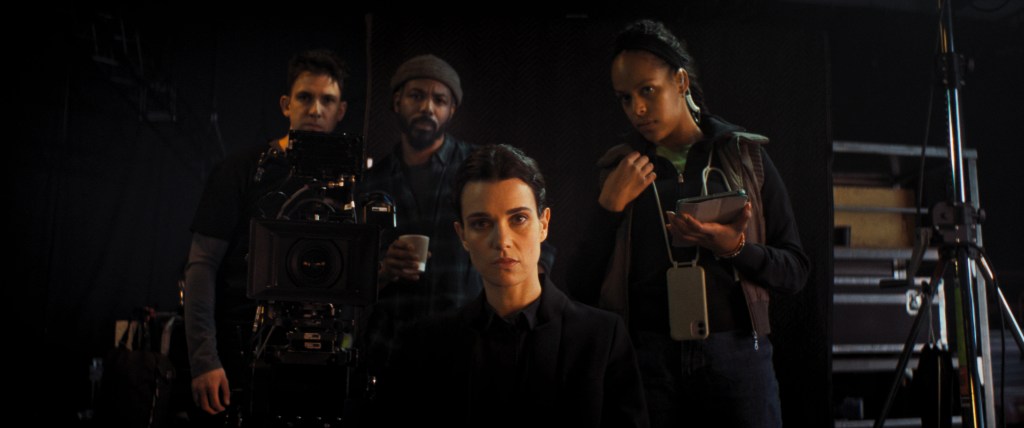
THE SECRET ASSISTANTS challenges the idea that confronting misconduct is
simply a matter of personal courage. Sophie understands what is happening, but she also knows that challenging a powerful industry figure could destroy the career she has worked so hard to build. What did you want to say about the unequal risks involved in speaking up?
I wanted to challenge the idea that speaking up is simply a question of courage. We rely far too much on the powerless to speak up, and we’re very quick to judge them when they don’t. There are so many films where a heroine takes down a corrupt system with nothing but her wits and determination. But in reality, most people in Sophie’s position never get to that Oscar-winning monologue moment. They don’t get there because they have weighed up the pros and cons and realise they have too much to lose. Of course, there are incredibly brave people who speak up, and thank goodness they exist. But I wanted to make a film for all the Sophies out there who find it incredibly hard to take on the system. I wanted the audience to be a silent witness to what unfolds in that room, so they could ask themselves an uncomfortable question: would I risk everything I’ve worked for to challenge a broken system with no guarantee that it would make a real difference, or would I choose to protect my own future?
Although the story is set within the machinery of filmmaking, its themes extend to any workplace where seniority, influence and opportunity are concentrated in the hands of a few. How deliberately did you shape the story to speak beyond the entertainment business, and what responses would you hope it prompts from audiences working in other industries?
It was crucial to me that this story could transcend its setting. Abuse of power is present in all industries, and it flourishes in highly competitive environments where people will put up with a lot just so that they can do their jobs. The dialogue never reveals exactly what Henry is accused of doing to Fiona Day, the PA
who has made accusations against him. I did this because I wanted anyone watching the film to be able to relate to the situation. It’s not about one form of abuse, it’s about the many ways in which power can be abused, across all industries.
I hope the story invites people’s imaginations to wonder into the gray areas that exist in these sorts of situations, even if just for a brief moment. I hope it offers some form of therapy for anyone who has ever been prey to a Henry Mann, and that some people might feel a little less alone in never finding the courage to stand up to their bullies. Above all, I hope it offers some perspective on why speaking up is so difficult and that this perspective might encourage people to change the system rather than relying on young debutant professionals to come forward and save the day.
Did the experiences of being women working in hierarchical production environments inform the film’s development, and how did you ensure the story addressed gendered power dynamics without suggesting that workplace misconduct is confined to one gender?
Yes – this film draws from my own experience of working my way up from a 17-year old intern to where I am today, as well as the experiences of friends and colleagues who have been on similar journeys in the film industry. It’s inspired by what we’ve each been through to secure positions in a highly competitive field. Our crew was 65 per cent female, largely because so many women in the industry related to the script and went out of their way to be part of the project. I wanted to show four women at different stages of their careers. We start with Jane, the
PA. She’s wide-eyed and bushy-tailed, taking notes on set and completely invested in the job. She needs to show everyone that she can be more than a PA, that she can step up and stand out from the others. Then there’s Mary, one of Henry’s personal executive assistants. She’s just stepped up from being a PA, she’s got her foot in the door, but now she needs to prove that she deserves to stay there. What sets her apart from all the PAs who want her job? She’d better show everyone, and fast.
Then there’s Sophie. She’s been Jane, she’s been Mary, and she’s made her way, step by painful step, to where she is now. She’s spent years learning her craft, and now she’s finally being given her big shot. She needs to prove she can do it. This is it. Another chance might not come around. And then there’s Jessica, the executive who arranges the interview and acts as Henry’s minder. She’s responsible to the shareholders and investors. She’s the big boss, at the height of her career, and yet she’s still subject to Henry’s abuse. What interested me was that all these women, regardless of where they are in their careers, have to play the game to get ahead or maintain their positions. It’s a delicate balance and a fine art. I also wanted to show that abuse does not discriminate. Anyone can abuse their power, and anyone can fall victim to abuse. It’s very rarely just about two people. There are
always witnesses, and there are often enablers. Abuse is not exclusive to one gender. Regardless of your gender or where you are in your career, you can fall prey to someone like Henry Mann. We see this towards the end of the interview, when Henry goes around the room and names people whose careers he claims to have built. When we see their reactions to being called out, we realise they’ve been through it too. Almost everyone in that room has been through it.
Katey Lee Carson and producer Rickie-Lee Roberts have spent years working as
assistant directors on productions for A24, MGM and Disney, including Skyfall, The
Imitation Game and Guardians of the Galaxy. What did your experience inside major
productions reveal about the relationship between power, access and professional
advancement, and how much of that experience found its way into the screenplay?
The film industry can be ruthless. It’s incredibly hard to get a foot in the door if you don’t have contacts, and once you’re in, you’re constantly having to prove that you deserve to stay, with 20 people lined up behind you waiting for your job. How much pressure can you take? How much are you willing to put up with to get ahead?
In the assistant directing world, especially for women, you have to consider your every move. It’s not just your voice, it’s how you speak, it’s your facial expressions, your clothing, every single choice you make. You have to be constantly alert and available, to the point where people avoid even going to the bathroom. I know PAs who don’t drink all day because they know they cannot be unavailable when called on. I’ve been one of them. The hours, the physical toll and, most importantly, the team dynamics are intense. Film is a team sport. You need to function as part of the team, and if you can’t, you’re out. When someone on that team is absolutely horrible to work with, you still have to tolerate them, because if you challenge their behaviour, you risk being seen as the one who isn’t a team player. And if that person has power, or is considered essential to the production, you can’t afford to be the one who rocks the boat. You end up having to work alongside someone who poisons the environment, while pretending everything is fine. Rickie-Lee and I both worked our way up from being on-set PAs, so we know these characters and their journeys inside out. I think most people working in film have their own
Henry Mann story. Making films is incredibly expensive, and where there’s a lot of money at stake, there’s inevitably a power imbalance. Some people are paid enormous sums while others are underpaid, and when your entire production hinges on those big players, you have a huge problem. People in these positions can become accustomed to never hearing the word “no”. They forget what it feels like to be told no, and come to expect a yes every time. And
that’s how they become these monsters, monsters that we’ve helped to create.
What do you think meaningful accountability looks like in practice, and how can the industry move beyond relying on individual acts of courage to address structural
problems?
The industry needs to stop hiring people with bad reputations. That is the only way to start dismantling these structural problems. That’s what accountability looks like in practice: if I hire someone or finance their project, I have a responsibility to make sure I’m not putting my money behind an awful human. There are so many wonderful crew members, actors and producers out there who are
beautiful beings and excellent at their jobs. Hire them. Give them the financing.
And, of course, there needs to be proper follow-up. If someone finds the immense courage to speak up, is there a real system in place where they will be heard, the issue will be addressed and they will be able to continue working? Or will they be put through hell, only for their abuser to take a two-week break while they never set foot in the industry again? Accountability is taking responsibility for who we hire, who we finance and who we continue to give power to.
How important was it that the film’s working practices aligned with its themes, and did you see the production itself as a practical demonstration of an alternative model?
It’s non-negotiable for Rickie-Lee and me that all the films we produce adhere to one strict rule: we won’t hire jerks. We don’t want to work with them, for them or near them. We want to build crews where people respect one another and create film sets that are safe. We believe that ultimately makes the film stronger.
With The Secret Assistants, because the film was so specifically about hierarchy and
power dynamics, we decided to extend the idea of mutual respect to pay. Everyone was paid the same daily rate, and it completely transformed the power dynamic. It made for such an enjoyable set. Everyone was on an equal footing, and everyone needed to be on their game all the time because we all had the same value. It was a great leveller.
Producing the film for £14,000 while implementing equal daily rates and an
opportunity for crew members to reinvest their fees was an ambitious undertaking.
How did you make the numbers work, and what compromises or creative solutions
were required to preserve both the production’s financial viability and its principles?
On a low-budget film, you have two options: don’t pay the crew, or have a tiny crew. We wanted to pay everyone on this film, and we knew we needed a decent-sized crew to make the film we wanted, so we came up with the equal-pay structure. This allowed the heads of department to crew their teams with the people they really needed, without too much hassle. Some people who didn’t need the money at the time chose to put their fees back into the film anonymously. Only the line producer knows who made that decision. We secured a lot of discounts and called in plenty of favours, but we never had to drastically cut corners. Everyone worked until we had what we needed to make the film properly. Every penny went to what you see in front of the camera, so to speak. There was no waste, in any shape or form, and in the end, it proved to be a very sustainable way to make a film.
When something was completely out of reach financially, the crew came up with wildly creative solutions that often worked perfectly. Film crews are natural problem-solvers. They love getting creative and finding ways to make things work, and my crew pulled out all the stops to get this film made. I think it proves that working within a tight budget doesn’t have to mean compromising on your principles. Sometimes, it forces you to find a better way and a great crew will always find a way to get you your shot – it’s up to you to not abuse that passionate dedication.
Having worked on major international productions, what did you want to take from
those experiences and do differently on THE SECRET ASSISTANTS? Do you think
smaller independent productions have a particular opportunity to experiment with
more equitable working practices, and what might larger companies learn from those experiments? We wanted there to be no pay gaps. One of the biggest issues on major productions is that the pay gap is becoming ridiculous. The majority of the budget goes to a handful of key players because, without them, the film wouldn’t get financed. Meanwhile, budgets are getting smaller, but the amounts going to those key players are staying the same or even increasing, leaving the crews squeezed into whatever is left. With The Secret Assistants, we wanted to try a different model. Everyone was paid the same daily rate, and the budget was completely transparent. Everyone could see where the money was going, and everyone knew they were being treated equally. Of course, our film didn’t have the high stakes of a major production, but it showed us that you can make
a film this way and still get the job done.
I think smaller productions have more freedom to experiment because they can build their own working practices from scratch. I’d love to see bigger companies take some of those ideas on board. You don’t have to treat people badly to make a great film, and you certainly don’t have to put people through hell to get the job done. Good working conditions make for a happier, more motivated crew. And perhaps it’s time the industry stopped relying on the same people and gave new talent and new ideas a chance.
With THE SECRET ASSISTANTS now BAFTA-qualifying, what does that recognition mean for you as filmmakers, particularly given the independence of the production and the values underpinning it? How do you hope the film will stand out within the wider short-film landscape?
It means so much to us to be BAFTA-qualifying, but not just for us. For every scrappy, tiny-budget short film out there, it shows that with the right people and the right idea, you can make a film that plays with the big kids.
We don’t have a major funding body behind us, an institution or a big-name production house. We’ve had to rely on the film itself, and we have a lot of faith in it. Of course, the competition will be incredibly tough, particularly against films with big budgets and big names attached, but I think our film has something different to offer. We made it independently, with a tiny budget, but with a brilliant cast and crew who believed in the story and in the way we wanted to make it. We stuck to our principles, paid everyone equally and made the film we set out to make.
Above all, I hope this recognition means more people get to see the film, and that the extraordinary work of my cast and crew gets the attention it deserves. Without them, there wouldn’t be a film.


Leave a Reply